No matter how big or small, every garden, whether ornamental or edible, starts with soil. My guest this week, British garden designer and Royal Horticultural Society gold medalist Juliet Sargeant, reveals the hidden power of soil in her new book and shares how gardeners can identify good soil.
Juliet is celebrated for her award-winning and socially conscious garden designs. She is a BBC Radio 4 “Gardeners’ Question Time” panelist and founded the Sussex Garden School, which offers a variety of in-person gardening, design and craft courses. Her new book is “Start with Soil: Simple Steps for a Thriving Garden.”
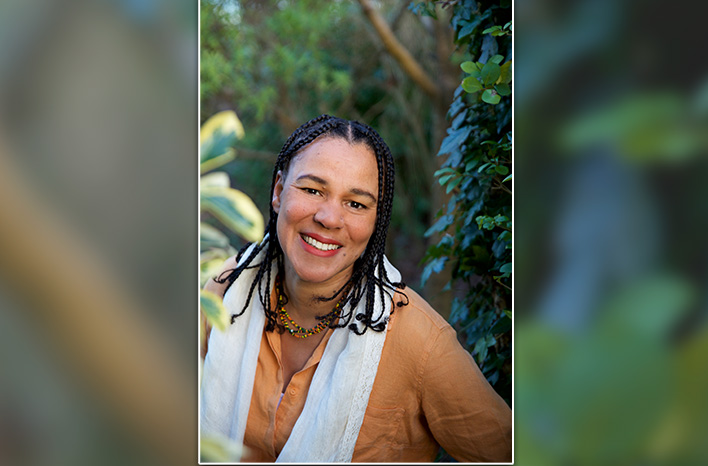
Juliet Sargeant is a BBC Radio 4 “Gardeners’ Question Time” panelist and founded the Sussex Garden School.
Photo Credit: Mariascard photography Brighton London
I first learned about Juliet while listening to “Gardeners’ Question Time,” my favorite British podcast. I have really enjoyed hearing Juliet on the show.
“I do encourage everybody to just learn about your own soil, have a look at it, test it,” Juliet says. “… Have a think about that whole world that’s going on beneath our feet. You know, we walk across it all day and we don’t think about it. But it supports everything. It supports all our food and everything that lives on this planet, It’s great stuff.”
Getting the Gardening Bug
“I always like to think that, for me, it didn’t actually start so much with gardens but with nature and landscape,” Juliet shares. “So I think like a lot of people of my age, I did a lot of playing outdoors, and my mom brought my brother and myself up on her own. So often she was at work and we were out in the woods playing. And it was just that wonderful sense of freedom and imaginative play that gives me so many happy memories. And I think my whole connection, really, with landscape and nature starts from those early days just being free playing in the landscape. And that’s one reason why I am so, so keen about creating gardens for families and children.”
She notes that many people who are interested in gardens as an adult started in childhood. Even if they lost interest as teenagers, they came back to gardening.
In the 1970s, when Juliet was about 7 or 8, her mother gave her a corner of the garden to do whatever she liked. In England back then, rockeries were very popular, so she started her own. Rockeries are gardens made with rocks and Alpine plants, with seeds planted in soil in the crevices.
“I suppose that was my first garden design, and I really got the bug,” she says, adding that watching tiny little seeds growing is miraculous.
Planting seeds is a gateway to gardening for children — and adults.
On my long-running PBS show “Growing a Greener World,” I interviewed Graham Kerr, a British cooking personality known as the Galloping Gourmet. He fell in love with gardening in his late 70s, even though he was involved in food his entire life. (His father was a hotel manager of five-star hotels in England.)
He never realized where the food came from until he moved to Mount Vernon, Washington, just north of Seattle. His neighbor welcomed him to the neighborhood by bringing him a packet of basil seeds. Graham planted the seeds and became hooked on gardening when he witnessed the basil germinate.
“Seed is such an easy gift,” Juliet says. “You don’t even have to buy them. You can share them from your own garden. Give them to somebody else and wait for them to get the bug.”
Juliet’s first career was in medicine. She worked as a junior doctor in the National Health Service. After four or five years, she felt worn out, and she wanted to do something more creative. So she studied garden design.
“I thought back to what I’d enjoyed in earlier years and went off, changed careers, went off to study garden design,” she recalls. “But at that time I didn’t really know the difference between gardening and garden design. So I thought I was training to be a gardener. Halfway through the course I realized, but it suits me. It suits me really well. And I’ve been doing that now for nearly 30 years.”
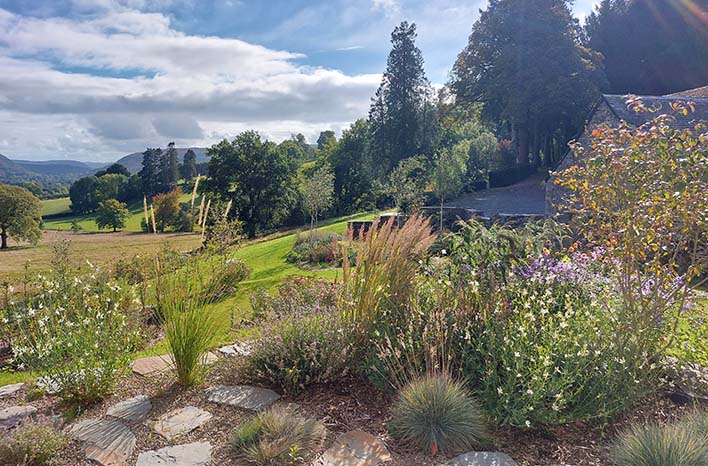
A garden by Juliet Sargeant at the Rhydoldog House in the rugged Elan Valley of Wales.
Courtesy of Juliet Sargeant
‘Gardeners’ Question Time’
“Gardeners’ Question Time” is a BBC Radio program with an all-star panel of horticultural experts. The panelists travel to different parts of England and host a town hall-style event where gardeners can ask them questions.
Juliet’s involvement with “Gardeners’ Question Time’ started just before the pandemic. She was initially contributing one-off feature recordings for them. During lockdown, she was asked to record from home on gardening topics of her choice. And after lockdown, she was asked to join the panel.
“You have no idea what these questions are going to be,” she says of serving on the panel. “We are not told in advance.”
She admits she was terrified at first, but she got through it.
“The audiences, they’re very friendly. So if ever we don’t know the answer — and of course that does happen, we’re human beings — we just say, oh, ‘I don’t know,’ or ‘pass.’ And hopefully, another member of the panel will quickly pick it up before anybody notices.”
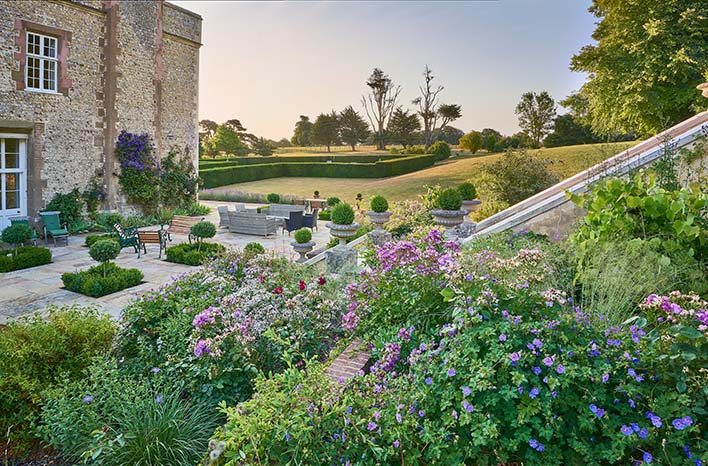
Photo Credit: Matthew J. Thomas
Starting with Soil
After three decades of making gardens professionally, Juliet is thinking more than ever about the impact of gardening and everyday activities on the environment.
“When I make gardens as a professional, I think of it as a really beautiful creative process,” Juliet says. “And we gardeners think of ourselves as the environmental good guys, but actually I started to think, am I always the good guy? You know, is some of what I’m doing actually quite destructive? So that question was sort of bubbling away in the back of my mind.”
Then in 2022 she had the opportunity to design a garden for the RHS Chelsea Flower Show to celebrate the British children’s television program “Blue Peter” — the longest running children’s TV show in the world.
“They wanted to celebrate ‘Blue Peter,’ but the subject — the actual subject of the garden — could be anything that I chose,” she says.
She decided she could make a garden that teaches children about the importance of looking after soil.
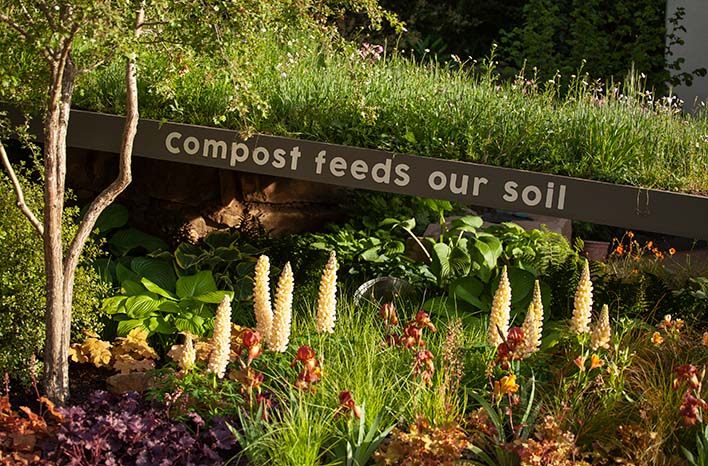
Juliet Sargeant’s “Blue Peter” garden at the 2022 Chelsea Flower show educated visitors about composting and caring for soil.
Photo Credit: Juliet Sargeant
Her Chelsea garden was a success, and then following year Juliet visited extended family in Tanzania, specifically on Ukerewe Island in Lake Victoria. When she visited their farm, she learned that their soil was poor and their crops were failing. They are subsistence farmers, so raising crops is not just a hobby for them.
When Juliet inspected the soil, it was dry and dusty, and when she had it tested, she learned it was really low in nutrients with practically no organic matter.
“I thought, we have to start talking about soil because we gardeners, we are using the soil all day, every day, planting things, expecting the soil to produce for us. But are we thinking about how we need to look after, nurture, protect the soil?”
She says it’s a bit like a contract: “If you look after the soil, the soil will look after you.”
How things got so bad on Ukerewe Island was unclear, but Juliet has her theories.
“I do wonder if, because fertilizers have become available, people have maybe forgotten old fashioned husbandry,” she says. “That’s probably true of us in the West as well. Because it’s so much easier to reach for a bottle than it is to remember your husbandry and care of the soil.”
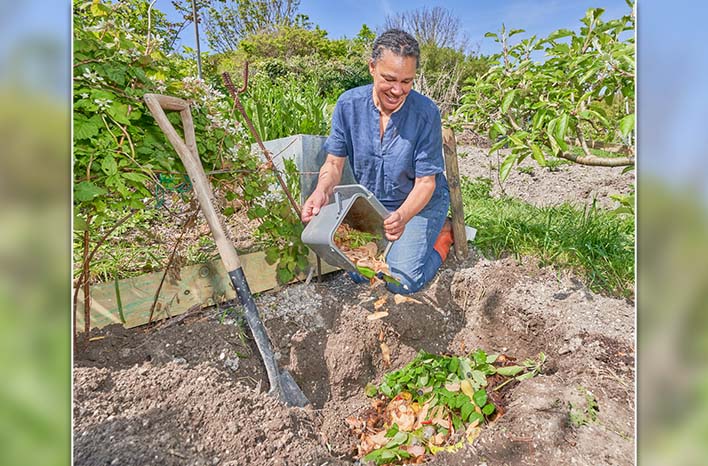
Juliet composts vegetables scraps and yard clippings right in the ground. Photo Courtesy of Juliet Sargeant
Take Advantage of Native Soil
“For years and years and years, I and most other gardeners have been in the tradition of improving our soil,” Juliet says. “And I started to think, well, why are we doing that? What does an improved soil look like? What is good soil? And then I started to think, well, as far as nature is concerned, good soil is the soil that is naturally there. And so that’s why I came to this conclusion that perhaps we need to have more of a nature focused idea of what good soil is.”
She adds that caveat that she is speaking about ornamental gardening. When it comes to vegetable gardening, improving soil fertility may be required.
When native soil is amended to grow an ornamental garden, it loses its local distinctiveness. Changing how sandy or clay the soil is and changing the pH may make it suitable for certain ornamental plants but unsuitable for other ornamentals that would naturally thrive there.
Here in Georgia, the soil is clay. So gardeners tend to add woodchips or other organic matter to the soil when planting. But when you do that and you put the tree or the shrub into that hole with all that cushy, beautiful organic matter and composted soil, the roots are so happy there that they have no desire to expand their reach into heavy, clay, poorly draining soil. Therefore, the plant never establishes to its fullest potential. And you miss out on an opportunity to backfill with the native soil. When the tree or the plant is immediately exposed to the native soil, it takes off from there.
In growing Georgia native plants, I witnessed how they don’t need me the way other plants do. When I stopped coddling them and watering them as much, they performed better because they are suited to the natural conditions of my Georgia garden.
“With your native plants, if you treat them mean and they grow lean, then they’re more resilient when, for example, climate change and adverse conditions come their way,” Juliet says. “Because in a natural situation, they would have to deal with all that without us pampering them.”
Having a less pampered garden may be necessary to remain resilient in the face of climate change.
“Everybody loves peonies and dahlias and delphiniums. Of course we all do. But are we going to be able to have those sorts of gardens in 20, 30 years time?” Juliet wonders. “I suspect we won’t be able to have those sorts of gardens. So maybe we just need to get smart now and start adapting.”
Keep Local Distinctiveness and Start Small
Juliet writes in “Start with Soil”: “If you have a garden with poor, shallow, or free draining sandy, gravel or chalk soil, you may want to improve areas so that you can grow food and traditional ornamental plants. However, in a garden planted on unimproved soil and populated with species adapted to that soil whilst not looking as showy, you’ll have greater local character and distinctiveness. It will also be much easier to maintain because you’re working with the natural tendencies of the site.”
Juliet points out that garden designers are often guilty of planting big — for instant impact.
She says the research shows that planting trees and shrubs small and allowing them the time to get their roots out and to adapt as they grow — rather than putting a semi-mature plant into a hole and expecting it to suddenly adapt — is a much better way of doing things.
A sapling will grow to a larger size in just a few years when compared to a balled and burlapped tree that needs time to recover from the root loss it suffered when it was dug for transplanting.
“So yes, it takes time, but isn’t that what gardening’s all about really?” she says.
You have to be patient with gardening. Expecting instant gratification can lead to disappointment.
Plant Your Pants
Juliet advises gardeners to “plant your pants.” But she doesn’t mean “pants” in the way Americans use the word. She means it in the British sense: “plant your underwear.”
It doesn’t actually have to be your underwear, but any cotton fabric.
“Because of course, cotton is plant material, and the idea is that if you put in the ground a piece of cotton fabric, the natural processes in the soil — the mini beasts and the microbes and the moisture in the soil, the fungi — will all very quickly start to get to work disintegrating and decomposing that cotton fabric. And the test is to plant your pants and then six weeks later, dig them up again and see what you’ve got left. Now if you have a healthy soil with lots and lots of activity going on, and the microbes are busy chomping everything up, then there’ll be very little left of your pants, just a few stringy bits. But if your soil is basically dead with nothing going on, your pants will come out in pristine condition.”
It’s a fun thing to do that engages both children and adults, she says.
Dr. Lee Reich, a soil scientist and repeat guest on “The joegardener Show,” is always curious about what else he can add to his compost pile to see how it breaks down over time. So he added a pair of Levi’s jeans to his compost bin. But when he took them out three years later, they were still largely intact. You could pretty much still wear them.
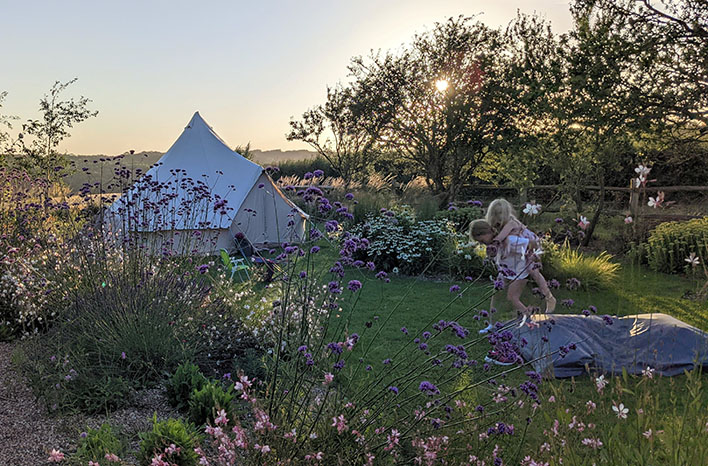
Planting seeds and watching them grow can lead to a lifelong love of gardening.
Photo Credit: Juliet Sargeant
Soil Perc Test
A soil percolation test is used to determine how well draining — or not — soil is.
This can be done very scientifically, but for the home gardener, it doesn’t need to be all that precise. Just dig a hole that is a couple of spade’s depth deep and about a foot square, then fill the hole with water and let it drain. Once the hole is empty, refill it, and this time, time how long it takes the water to drain away.
Juliet’s book explains what conclusions to draw based on how many hours the hole takes to drain.
Soil Aggregation Test
A soil aggregation test, or slake test, will reveal soil tilth — its suitability for planting crops in.
“Soil particles are naturally clumped together into little groups called aggregates, and they are stuck together with natural biological glues,” Juliet explains.
These glues come from roots and soil microbes.
“If you have a very poor soil, then it tends to crumble and fall apart. It doesn’t have these glues, so it doesn’t have that lovely natural structure,” she says. “And you can test the structure of your soil by getting a jam jar, fill it with water, and then you get a little piece of metal mesh.”
Get a clump of dry soil from your garden, and place it in the sieve or hardware cloth, so the soil sits in the water in the little basket. How long it takes the soil to disintegrate once suspended in the soil will reveal the quality of the soil structure.
Notably, the Rodale Institute did this as a demonstration to show how organically maintained soil has better structure than typical soil maintained with commercial agriculture methods. Pool soil just falls right apart.
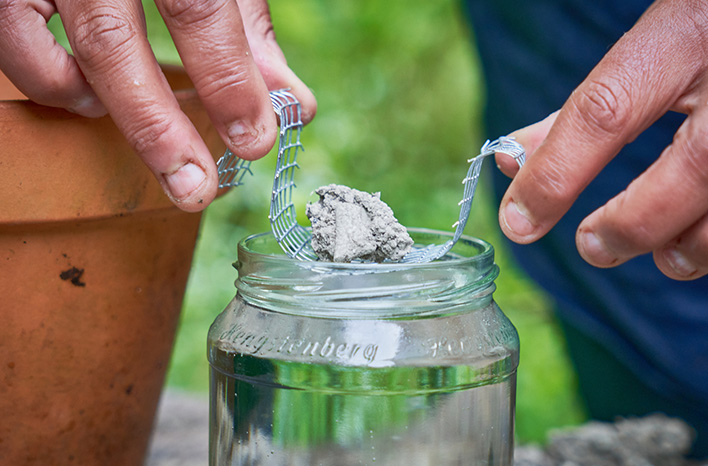
How long it takes the soil to disintegrate once suspended in the soil will reveal the quality of the soil structure. Photo Credit: Matthew J. Thomas
Buyer Beware
The U.K. has very specific classifications for topsoil. Peat-free high quality planting topsoil has the designation bs3882.
In the United States, when you blindly order “topsoil,” you don’t know what you are going to get.
I once ordered a topsoil delivery, and I was sick to my stomach when it was dumped from the truck: It contained glass, plastic, bottle caps and other trash.
Buyer beware. Before you order topsoil sight unseen, go see it and touch it, grab it, squeeze it, smell it, look at the color of it. Decide whether it’s something you really want in your yard before you hire somebody to load it up in a truck to deliver to your house. Because you can’t put the toothpaste back in the tube once it’s out.
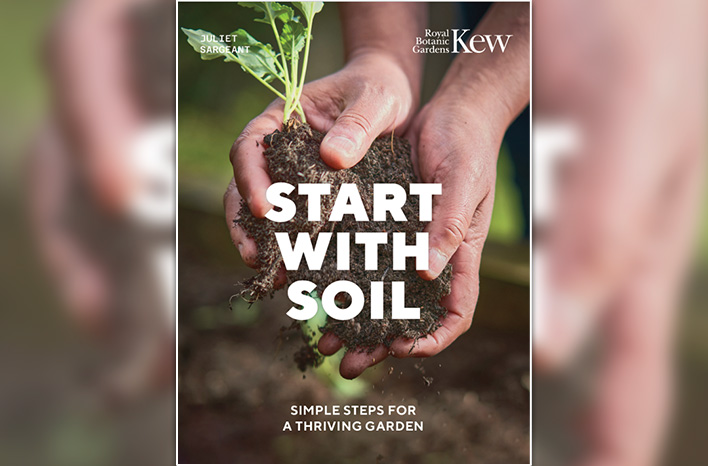
Juliet Sargeant’s book “Start with Soil.”
I hope you enjoyed my conversation with Juliet Sargeant on “Start with Soil.” If you haven’t listened yet, you can do so now by scrolling to the top of the page and clicking the Play icon in the green bar under the page title.
How have you improved your soil for gardening, or alternatively, how have you changed your gardening style to be suitable for your native soil type.? Let us know in the comments below.
Links & Resources
Some product links in this guide are affiliate links. See full disclosure below.
Episode 013: Backyard Composting – Confessions of an Obsessed Composter with Lee Reich
Episode 153: The Science Behind Great Soil
Episode 223: How Soil Microbes Make Good Soil Great
joegardener Online Gardening Academy™: Popular courses on gardening fundamentals; managing pests, diseases & weeds; seed starting and more.
joegardener Online Gardening Academy Organic Vegetable Gardening: My new premium online course. The course is designed to be a comprehensive guide to starting, growing, nurturing and harvesting your favorite vegetables, no matter what you love to eat, no matter where you live, no matter your level of gardening experience.
joegardener Online Gardening Academy Master Seed Starting: Everything you need to know to start your own plants from seed — indoors and out.
joegardener Online Gardening Academy Beginning Gardener Fundamentals: Essential principles to know to create a thriving garden.
joegardener Online Gardening Academy Growing Epic Tomatoes: Learn how to grow epic tomatoes with Joe Lamp’l and Craig LeHoullier.
joegardener Online Gardening Academy Master Pests, Diseases & Weeds: Learn the proactive steps to take to manage pests, diseases and weeds for a more successful garden with a lot less frustration. Just $47 for lifetime access!
joegardener Online Gardening Academy Perfect Soil Recipe Master Class: Learn how to create the perfect soil environment for thriving plants.
GGW Ep 209: Edible Landscaping with Graham Kerr
Juliet Sargeant on Instagram | @julietsargeant
Sussex Garden School on Instagram | @sussexgardenschool
Juliet Sargeant’s Sussex Garden School on Facebook
“Start with Soil: Simple Steps for a Thriving Garden” by Juliet Sargeant
Milorganite® – Our podcast episode sponsor and Brand Partner of joegardener.com
Soil3 – Our podcast episode sponsor and Brand Partner of joegardener.com
Disclosure: Some product links in this guide are affiliate links, which means we get a commission if you make a purchase. However, none of the prices of these resources have been increased to compensate us, and compensation is not an influencing factor on their inclusion here. The selection of all items featured in this post and podcast was based solely on merit and in no way influenced by any affiliate or financial incentive, or contractual relationship. At the time of this writing, Joe Lamp’l has professional relationships with the following companies who may have products included in this post and podcast: Milorganite, Soil3, Territorial Seed Company, Proven Winners ColorChoice, and Dramm. These companies are either Brand Partners of joegardener.com and/or advertise on our website. However, we receive no additional compensation from the sales or promotion of their product through this guide. The inclusion of any products mentioned within this post is entirely independent and exclusive of any relationship.


