



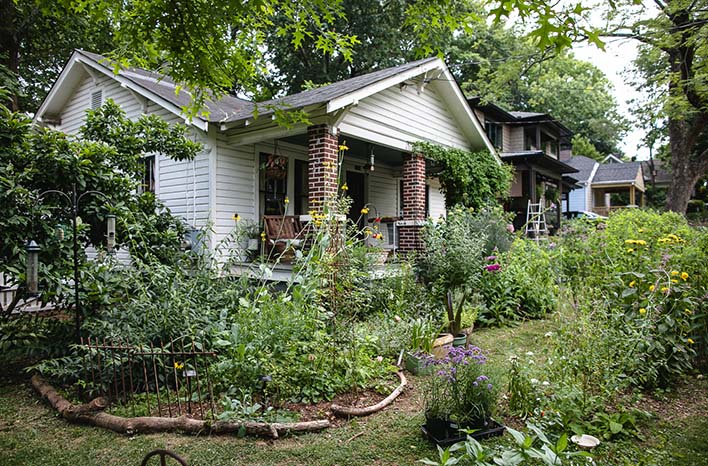
Practicing permaculture doesn’t require a sprawling property of several acres. As my guest this week, Brandy Hall of Shades of Green Permaculture, explains, the benefits of permaculture can fit in urban and suburban settings.
Brandy founded her regenerative landscape design/build company Shades of Green in 2008 in Avondale Estates, Georgia, in the Atlanta Metropolitan Area. She drew the name Shades of Green from her fundamental belief that wherever you’re from, whatever your background, and however you’re willing to contribute to the regeneration of the planet, your particular shade of green is not just important, but essential.

Brandy Hall is the founder and CEO of Shades of Green Permaculture. Her upcoming book is “The Complete Guide to Home Permaculture.”
Photo Credit: Jonathan Banks
Brandy earned her general contractor’s license once she completed her undergraduate studies at the age of 20 and began training as a stone mason. She has nearly two decades of experience in off-grid water systems, landscape construction and integrated farming systems. She’s also the mayor of the City of Pine Lake, her Georgia hometown. Her upcoming book is “The Complete Guide to Home Permaculture: How to Transform Your Yard into a Thriving and Productive Ecosystem.”
“At the heart of the work, for me … it’s less about growing all your own food and living completely off grid and all of that,” she says. “It’s really about nurturing our connection to life.”
Brandy and her staff of more than 25 employees have worked with more than a thousand clients who are applying permaculture in various ways.
“Most of our clients come to us because they have a sense that they want to participate in the earth’s return to health,” she says.
By 2050, 68% of people will live in city centers, according to the United Nations, Brandy points out.
“So the connection we have to nature and the life we can nurture really is in our yards and in our green spaces,” she says.
One small solution has a big impact and can inspire our friends, neighbors and family to follow our example, Brandy notes. “From a tiny ember, a huge fire rages.”
Brandy Hall’s Formative Years
Brandy grew up splitting her time between South Florida and Western North Carolina. In Florida, she lived on a farm of 15 acres of hot houses, shade houses, field plants and canals.
Her mother and stepfather developed sensitivities to the agricultural chemicals they were spraying, such as diazinon. It got to the point that her stepfather’s joints were so swollen he needed a wheelchair to get around, and when her mother was exposed to chemicals, she convulsed. They decided they needed to move off the farm.
“It was a very formative experience witnessing that in my parents,” Brandy says.
Expressions of Eco-conscious Land Management
Permaculture, regenerative landscaping and ecological gardening are all expressions of land management that we may arrive at for different reasons, but the end result is nurturing life, Brandy says.
“Permaculture really puts an emphasis on permanent agriculture — so growing food,” she says. “And in our context, I like to extend that to think beyond just the human. So it’s growing food for our human sustenance, but also for the wildlife and the pollinators and the non-human world that doesn’t have as ready access in urban and suburban centers as they may have 50 years ago.”
The regenerative component is about “closing all the loops” and asking, “How do we cycle waste? How do we cycle water? How do we interact in a way that’s going to continue to nurture the health of the landscape?” she explains.
Ecological gardening is thinking about the ecology of the landscaping, from the soil microbiome to the pollinators and birds that the landscape supports.
All three of these disciplines, although they have unique applications, tend to arrive at many of the same points.
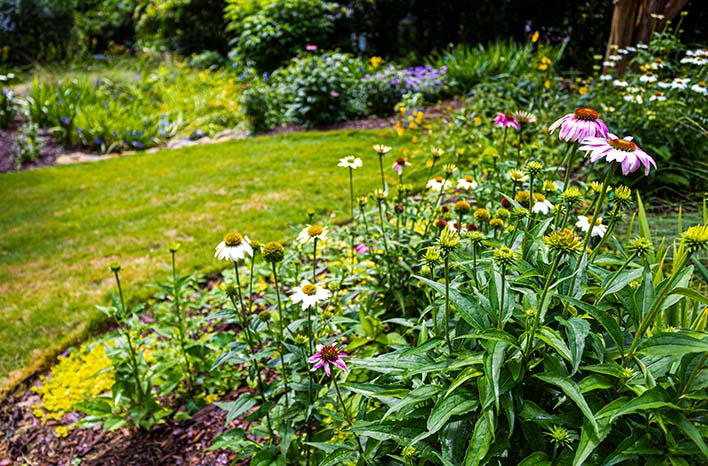
Permaculture, regenerative landscaping and ecological gardening are related and are adopted for many of the same motivations.
Photo Credit: Jonathan Banks
Brandy’s Three Pillars
Brandy had taught permaculture design certification courses in person, but then during the COVID period, she moved her lessons online. She decided to pare the courses down from 12 principles with various tools and techniques to something more relatable and useful for the person with just a normal-size yard to work with in an urban or suburban setting.
“I’m not growing all of my own food, and I’m not doing keyline swales because I have 6,000 square feet to work with,” she says.
“It doesn’t really matter what the techniques are, what you’re planting exactly, or exactly how you’re building soil, or exactly how you’re sinking water. You’re, you’re practicing the heart of regeneration as a land steward.”
Pillar 1: Work with Water as a Resource
Brandy says it’s so easy when we can just turn on a spigot, even during a drought, and get all the water we want. Though for people in arid climates, that’s not always the case. And no matter where you live, you should treat water as valuable.
“The main function when we think about restoring the water cycle is, how do we accept the rain that we have and how do we sink it into our landscape so that we can build the soil’s capacity to hold water?” Brandy says.
“Slow it, sink it, spread it” is the advice Brad Lancaster gives in his book “Rainwater Harvesting for Drylands and Beyond.”
Adding organic matter is one way to accomplish this. Using cisterns and other water-harvesting devices also helps to keep water from running off a property, where it can contribute to flooding or stormwater pollution of water bodies.
“If you’re sinking it into the soil, you don’t need to irrigate as much, so it’s lower maintenance,” Brandy points out.
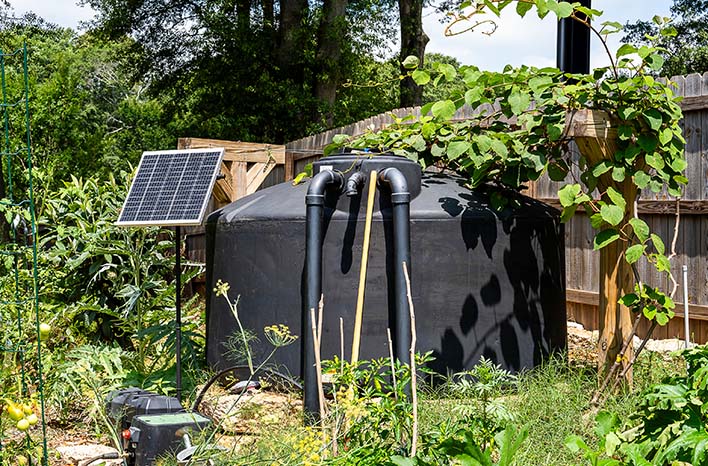
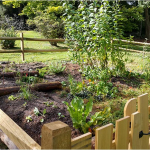
Cisterns retain rain water so it can be used during a dry period.
Photo Credit: Ash Authur
Pillar 2: Integrate Waste as a Resource
When building soil, Brandy doesn’t concern herself with what a soil test may have to say about the pH level and NPK balance. She just adds organic matter and lets Mother Nature do the rest.
“To make it approachable for just an average person who’s working in their yard, who’s not going to be testing rigorously and all of those things, the main thing I want to hit home is that if we build the organic material in our soil, everything’s going to be better off for it,” she says. “It’s going to stay more hydrated, there’s going to be more fungi, there’s going to be more beneficial bacteria, there’s going to be more opportunities for all kinds of things to grow.”
In her book, she lays out her techniques for building organic material in the soil. The methods depend on what you are trying to accomplish, such as replacing a conventional yard with a meadow.
“There’s a million techniques,” she says. “The heart of it is, let’s keep our waste on site, meaning our food scraps and our leaves.”
When building the soil microbiome, consider if the intended plant species for that area prefer a more fungal-rich soil or more bacteria-rich soil. For instance, woodland species and shrubs prefer fungal-rich soil, which can be achieved by adding more wood chips and leaves, while vegetable plants, perennials and grasses prefer more bacteria rich soil, which can be achieved by adding compost tea and worm castings.
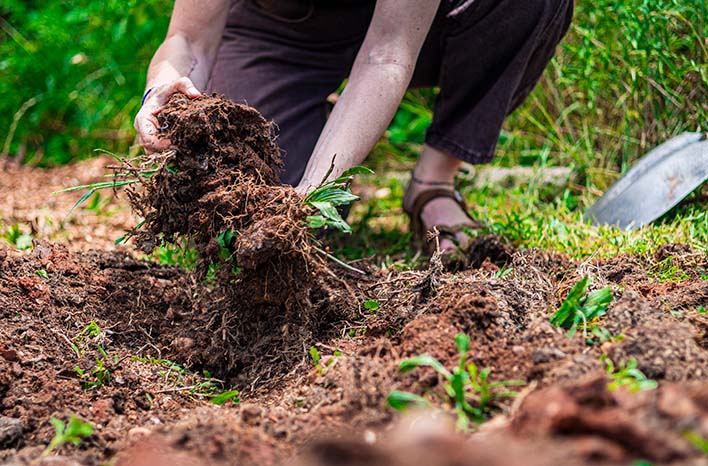
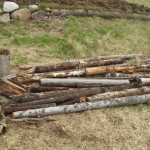
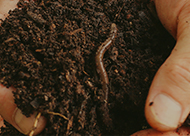
Adding organic matter to soil improves both water retention and fertility, reducing the need for chemical inputs.
Photo Credit: Jonathan Banks
Pillar 3: Preserve and Restore Biodiversity by Rebuilding Plant Communities
Dave Jackie who wrote “Edible Forest Gardens” says, “Don’t plant plants. Plant ecosystems.”
“It’s about not thinking about plants in isolation, but thinking about how plants build resilience in our landscape by serving many functions,” Brandy says.
In her book, she lays out 13 functions in a landscape within an urban or suburban context. This includes adding nutrients to the soil, using deep taproot plants to pull nutrients up.
“You want varied root structure,” Brandy notes. “Different types of root structures play a role in the soil health. That can be like adding nitrogen fixers, like all of your legumes or clover to your yard. So every time you chop that back, the roots die back a little bit and release nitrogen. So you have a natural fertilizer source instead of adding synthetic nitrogen.”
Brandy spoke at the same symposium a while back as Nancy Lawson, the author of “The Humane Gardener: Nurturing a Backyard Habitat for Wildlife.” Nancy pointed out that people wonder why wildlife is “eating everything” in their yard. But when that “everything” is just one rose bush, it’s no wonder that it’s being eaten up.
Given plenty of food sources, wildlife won’t put too much pressure on any one plant. Plant abundantly, and the insects, birds and other creatures won’t chow down to the point that the plants suffer.
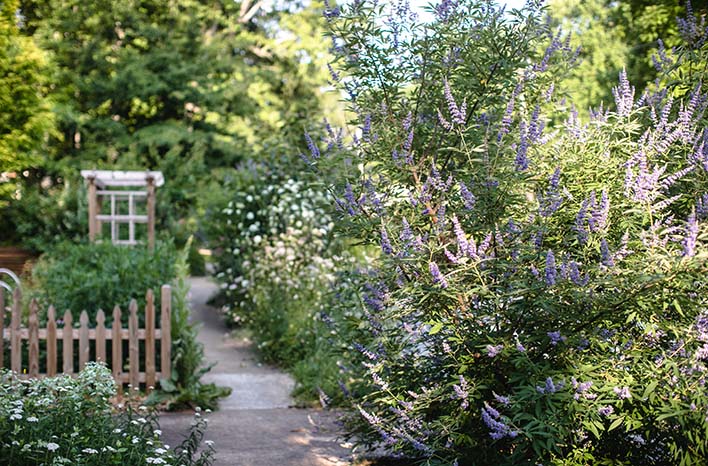
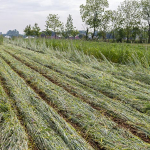
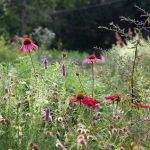
When growing an abundance of plants, more wildlife is served and individual plants are less stressed by hungry insects and birds.
Photo Credit: Erik Meadows Photography
I hope you enjoyed my conversation with Brandy Hall on permaculture. If you haven’t listened yet, you can do so now by scrolling to the top of the page and clicking the Play icon in the green bar under the page title.
Do you practice permaculture on any scale? Let us know in the comments below.
Links & Resources
Some product links in this guide are affiliate links. See full disclosure below.
Episode 201: Understanding Regenerative Agriculture and Permaculture, with Dr. Jake Mowrer
Episode 426: Global Permaculture & Africa’s Great Green Wall
joegardener Online Gardening Academy™: Popular courses on gardening fundamentals; managing pests, diseases & weeds; seed starting and more.
joegardener Online Gardening Academy Organic Vegetable Gardening: My new premium online course. The course is designed to be a comprehensive guide to starting, growing, nurturing and harvesting your favorite vegetables, no matter what you love to eat, no matter where you live, no matter your level of gardening experience.
joegardener Online Gardening Academy Master Seed Starting: Everything you need to know to start your own plants from seed — indoors and out.
joegardener Online Gardening Academy Beginning Gardener Fundamentals: Essential principles to know to create a thriving garden.
joegardener Online Gardening Academy Growing Epic Tomatoes: Learn how to grow epic tomatoes with Joe Lamp’l and Craig LeHoullier.
joegardener Online Gardening Academy Master Pests, Diseases & Weeds: Learn the proactive steps to take to manage pests, diseases and weeds for a more successful garden with a lot less frustration. Just $47 for lifetime access!
joegardener Online Gardening Academy Perfect Soil Recipe Master Class: Learn how to create the perfect soil environment for thriving plants.
“The Complete Guide to Home Permaculture: How to Transform Your Yard into a Thriving and Productive Ecosystem” by Brandy Hall
“Rainwater Harvesting for Drylands and Beyond” by Brad Lancaster
“The Humane Gardener: Nurturing a Backyard Habitat for Wildlife” by Nancy Lawson
Disclosure: As an Amazon Associate, I earn from qualifying purchases. I receive a commission every time you purchase a product through an Amazon affiliate link. Some product links in this guide are affiliate links. However, none of the prices of these resources have been increased to compensate us, and compensation is not an influencing factor on their inclusion here. The selection of all items featured in this post and podcast was based solely on merit and in no way influenced by any affiliate or financial incentive, or contractual relationship. At the time of this writing, Joe Lamp’l has professional relationships with the following companies who may have products included in this post and podcast: Milorganite, Soil3, Territorial Seed Company, Cool Springs Press / Quarto Group and Dramm. These companies are either Brand Partners of joegardener.com and/or advertise on our website. However, we receive no additional compensation from the sales or promotion of their product through this guide. The inclusion of any products mentioned within this post is entirely independent and exclusive of any relationship.